Ex-OpenAI researcher launches Jev, a decision model he says runs 20-200x faster than LLMs
Diogo Almeida, who says his OpenAI work became the research behind ChatGPT, launched Jev: a model that returns typed decisions instead of text. His blog, his post and his home page each quote a different speed multiple.

Ex-OpenAI researcher launches Jev, a decision model he says runs 20-200x faster than LLMs
A researcher who helped build ChatGPT launched a model that returns decisions instead of text, and quotes three different speed multiples for it across his own blog, post and home page. Perplexity says two engineers and hundreds of coding agents built its new production database, then spells out what the engineers still did. OpenAI's engineers describe a tenfold load jump from agent-written pull requests. And a developer thirty years in argues the code got faster and the learning did not.
Models
Ex-OpenAI researcher launches Jev, a decision model he says runs 20-200x faster than LLMs
Diogo Almeida, who says his OpenAI work "ended up as the research behind ChatGPT," launched TypeSafe AI's first model, Jev, in early access on Tuesday. It is not a chat model. In his words it is "a frontier-intelligence function call: unstructured state in, typed probabilistic decisions out," built for the yes-or-no calls software already makes with if-statements. Input costs $0.042 per million tokens and output is free. The speed claim moves with the surface: the blog says "40x-200x faster," his launch post says "20-200x faster" and "40-400x cheaper," and the home page runs "193.6x faster, 444.6x cheaper." The same blog names why the numbers may run hot. Its reference answers average two rivals' models, its test workflows came from "our model capabilities team, so some bias could exist," and its 0% type-error figure is "not empirical." No outside benchmark has run it at the claimed multiples.
After co-inventing ChatGPT, I kept asking myself: why have superhuman chat models not led to AGI?
— Diogo Almeida (@CompleteSkeptic) September 15, 2026
I’ve spent the last 2 years in stealth building a new way to train models (RLCD), and a new type of frontier AI model that we are releasing today: Jev
• 20-200x faster
• 40-400x… pic.twitter.com/JSybNG2BKJ
Straight from the builders
Perplexity says two engineers plus hundreds of agents built its database — in two months
Perplexity says its key-value store, CobbleDB, cut batch-read latency from 31.4 to 5.60 ms against DynamoDB and should cost at least 20% less, on an internal cost model. The build claim: "two human engineers and hundreds of AI agents in two months," for roughly 40,000 lines of Rust. Later the same post says engineers "set the architecture, reviewed consequential changes, and authorized production operations"; agents did "continuous inspection and follow-through." X's headline added "saves millions." Perplexity's post does not.
We’re publishing research on how we built CobbleDB, our key-value database that serves web content for Perplexity search.
— Perplexity (@perplexity_ai) September 15, 2026
Two engineers and a team of hundreds of proactive, always-on AI agents built the core infrastructure in two months. pic.twitter.com/OsCtY15UW6
OpenAI's VP on Codex: 10x more load on some systems in six months
Gergely Orosz interviewed seven named OpenAI engineers about Codex. VP Venkat Venkataramani says pull requests per engineer are "growing like a hockey stick," with "roughly a 10x increase in load on some systems" in about six months. Non-engineering teams went from "~0% usage of Codex to 90%" in four months, on a chart captioned "Source: OpenAI." The piece's own caveat: internal Codex "is a lot more advanced than its external counterpart." Paid piece; every quote here is free to read.
 Gergely Orosz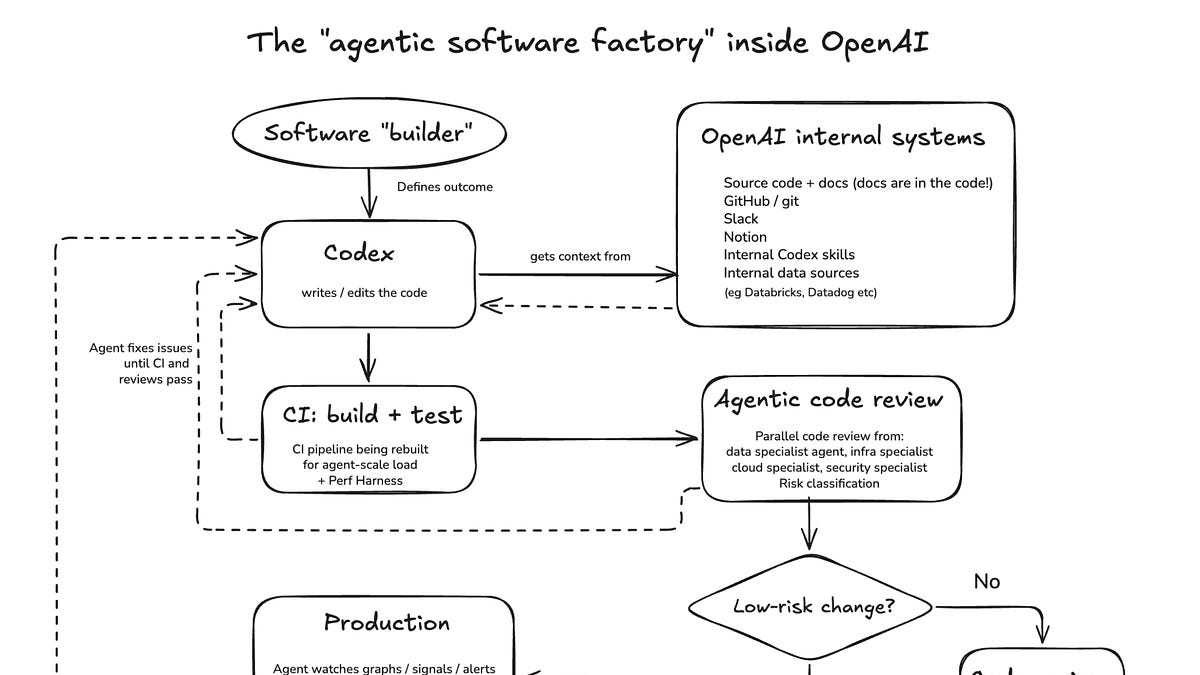
Reality check
A 30-year developer says LLMs make code faster but not the learning behind it
Mark Seemann, answering a reader who built a system "above my own level of understanding," argues the limit is "how fast a human brain can absorb new knowledge." He grants with LLMs "you can learn faster, because you can ask more directed questions." His rule: "Understand the level of abstractions directly below the one you work in, as well as the one above." He says up front he leans against AI. One engineer's argument, no data, and he says so.
 Mark Seemann
Also worth your time
- Factory, the company, raises $200M at a $5B valuation — not OpenAI's internal "software factory" above. Its own post names Blackstone, Sequoia and Khosla among the investors, puts total funding over $400 million, and repeats an April claim that its model router cut token spend "by more than 60%." The round is absent from Hacker News.
- Cloudflare adds a "Disallow AI Training" setting; its new Agent crawler category has no Disallow yet — Cloudflare's own numbers: "less than 1% of Cloudflare sites choose to block Search bots," while "17% of sites choose to enable some mechanism to block training." On agents: "the Internet does not yet have a well-established directive for expressing Disallow preferences to agents."
Ones to watch (early, unverified): Datamimic, a synthetic test-data generator pitched as "don't let your coding agent invent its own test world," 47 points on Hacker News and about 85 GitHub stars. On-beat by subject, well under the bar by size.
Know someone who'd want this in their inbox? Forward it — that's how this grows. And if we got something wrong, or you think we buried the real story today, hit reply. A person reads every one.
The New Way is written with AI. It gathers the day's stories, checks them against their sources and drafts every summary. A person decides what runs and reviews every issue before we hit send.